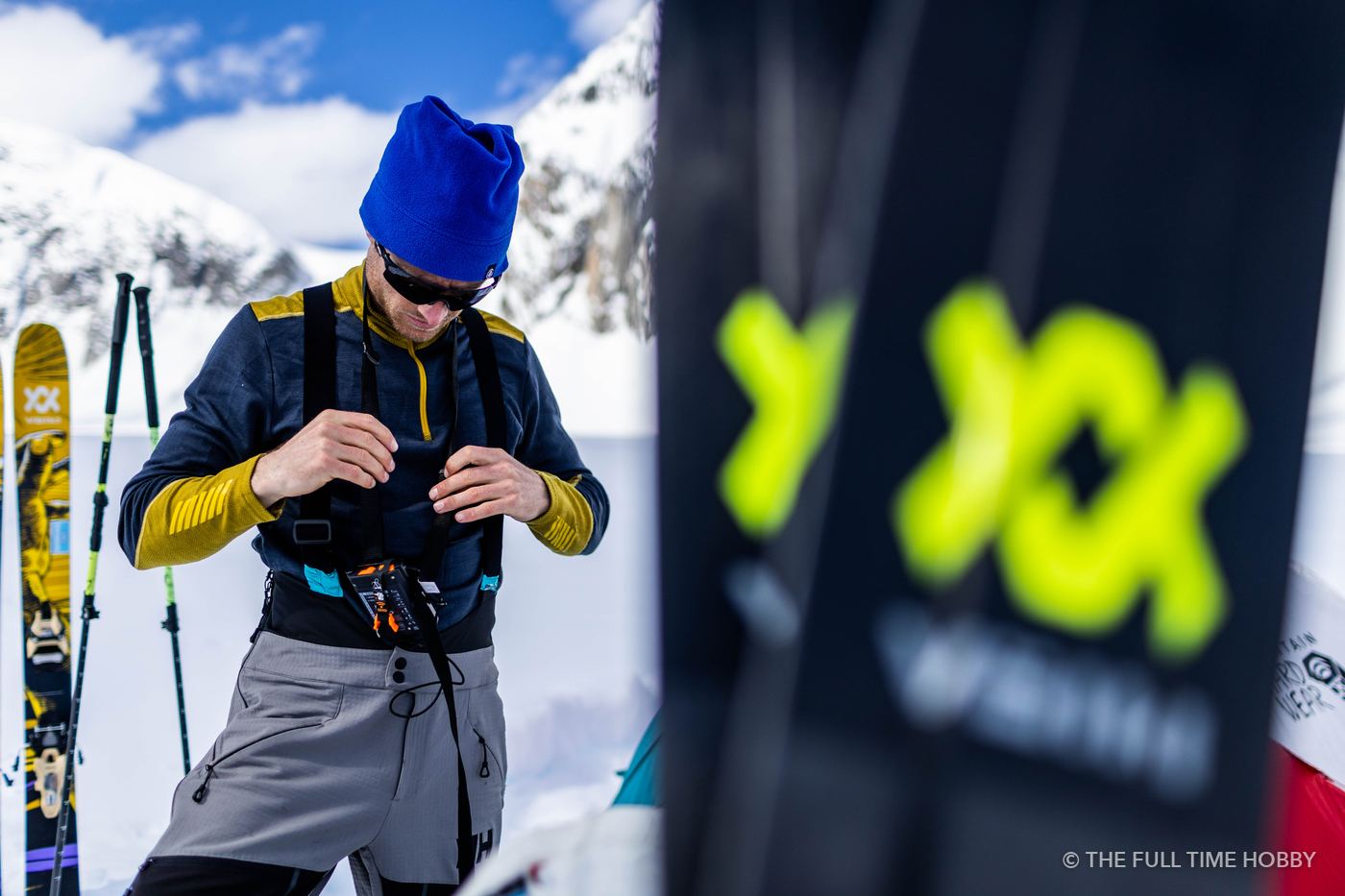
Every gram you carry uphill costs you energy, and every minute you spend fumbling with gear in the cold costs you shots. The goal is a kit that is light, fast and reliable at minus 15.
Camera body
You want a weather-sealed body with fast continuous autofocus and a good burst rate. A full-frame mirrorless like the Canon R5 is my go-to: it tracks skiers well, handles cold, and gives you enough resolution to crop. Mirrorless cameras eat batteries faster, though, which brings us to…
Batteries (bring more than you think)
- Cold kills battery life. Bring at least three, and keep spares in an inside pocket close to your body.
- Swap a cold battery for a warm one, then warm the dead one back up. It’ll often come back to life.
Lenses
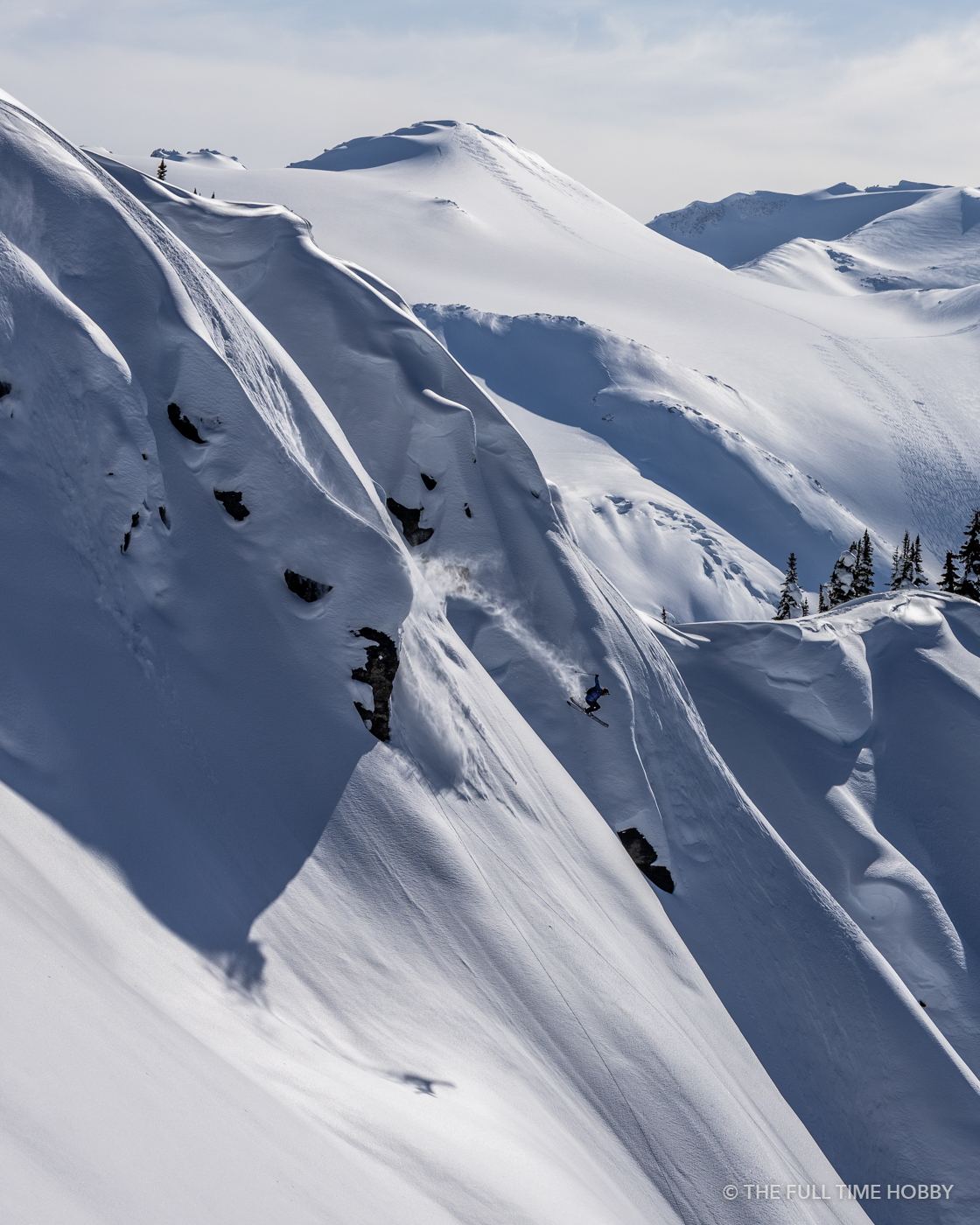
- 70–200mm f/2.8: the ski lens. Compresses the mountain behind the skier, isolates the turn, and lets you shoot from a safe spot.
- 16–35mm or 24–70mm: for the big-landscape, tiny-skier shots and for close action with lots of sky.
- 150–600mm (optional): for faces across a valley or lines you can’t get close to.
Pack and accessories
- A camera pack with back-panel access, so you can get the camera out without putting your pack in the snow.
- A chest or hip holster for fast resort laps.
- Lens cloths in a dry pocket, plus a microfibre towel. Snow on the front element ruins frames.
- Thin liner gloves so you can work the buttons, with big mitts over the top.
- A polarizer for cutting glare on sunny days, used carefully on wide lenses so the sky stays even.
Safety gear is camera gear
If you’re leaving the resort boundary, your transceiver, probe and shovel come before any lens, along with avalanche training and a partner. Check Avalanche Canada before every trip. No photo is worth it.
Settings that work in snow
- Exposure: snow fools your meter into underexposing. Dial in +0.7 to +1.3 exposure compensation and check your histogram.
- Shutter: 1/1000s or faster to freeze a turn; 1/2000s for big airs.
- Focus: continuous AF with subject tracking, burst mode on.
- Coming inside: put the camera in a sealed bag before you go into a warm lodge, to stop condensation forming inside the lens.
Don’t own it? Rent it
You don’t need to buy a whole kit for one trip. I rent out the same gear I use on commercial shoots: the Canon R5, Canon 70–200mm f/2.8, Tamron 150–600mm and Godox AD600 Pro, with pickup in Squamish. See camera gear rentals.
Quick answers
What is the best lens for ski photography?
A 70-200mm f/2.8 is the most useful single lens for ski photography. Pair it with a wide zoom for landscapes.
How do I keep camera batteries warm while skiing?
Carry spares in an inside pocket close to your body, and swap a cold battery for a warm one. Bring at least three.
What camera settings should I use for skiing photos?
Use 1/1000s or faster, continuous autofocus, burst mode, and +0.7 to +1.3 exposure compensation so the snow stays white.
Can I rent a camera for ski photography in Squamish or Whistler?
Yes. Canon R5 bodies, telephoto lenses and strobes are available to rent in Squamish through The Full Time Hobby.